
Protecting
Earth's Main Pollinators
Bees are among the most electromagnetically sensitive species on the planet. The same magnetic navigation system that makes them extraordinary pollinators also makes them acutely vulnerable to artificial EMF. The Apiary Protection Project is EFEIA's response to that vulnerability.
food crops depend on animal pollination
comes from pollinator-dependent crops
artificial EMF and wildlife
One of the Most Electromagnetically Sensitive Species on Earth
Bees are not passive travelers. They navigate using the Earth's magnetic field, a biological capability called magnetoreception. Magnetite crystals in their abdomens act as biological compasses, orienting bees relative to the planet's geomagnetic field during foraging runs that can cover several kilometers.
This exquisite sensitivity to natural electromagnetic fields is what makes bees exceptional pollinators. It is also what makes them uniquely vulnerable to artificial EMF. Artificial fields generated by wireless infrastructure, power lines, and electronic devices may interfere with that navigation system.
Many wild pollinator populations are declining, and managed honeybee colonies face high losses in many regions. Pesticides, habitat loss, and pathogens all play documented roles. A smaller body of research examines electromagnetic pollution as a possible, underexamined contributor to colony health deterioration.
publications referenced in this project
documented EMF impact categories on bee colonies
project objectives across research, solutions, and advocacy
How Bees Navigate: Magnetoreception
Bees contain magnetite crystals — iron-based biological structures that respond to the Earth's geomagnetic field. This gives them an internal compass accurate enough to navigate across kilometers of terrain and return precisely to their hive.
The same sensitivity means their navigation system responds to any magnetic or electromagnetic disturbance in their environment. Researchers are investigating whether weak artificial fields can interfere with this system at the frequencies it uses.
Beyond navigation, bees communicate food locations through the waggle dance: a body-movement signal encoding direction and distance relative to the sun. Some researchers report that this signaling is also susceptible to electromagnetic interference, which could reduce the ability of the colony to coordinate foraging.
At the colony level, the result is compounded: disoriented individuals, disrupted communication, reduced foraging efficiency, and a proposed link to Colony Collapse Disorder that still needs controlled research.
The Impact of Electromagnetic Pollution on Bees
Research across multiple institutions has examined four primary categories of potential harm to honeybee colonies from artificial EMF exposure.
Disorientation and Navigation Failure
Artificial EMF may disrupt magnetoreception and homing, leaving foraging workers unable to return and reducing colony food intake. Controlled field studies of navigation are still limited.
Ref: Shepherd et al., 2018 (laboratory study of flight and foraging)Colony Collapse Disorder (CCD)
Some authors propose non-ionizing radiation as a possible factor in CCD, the sudden and unexplained disappearance of worker bees from hives. A 2018 hypothesis paper (Santhosh Kumar, Bioinformation) proposed EMF as a contributing factor and called for research to test it.
Ref: Santhosh Kumar, 2018Waggle Dance Disruption
The waggle dance is a precision communication system. Researchers have proposed methods to test whether EMF exposure interferes with this behavior, which could reduce the accuracy of food-source signaling and the collective ability of the colony to locate foraging resources.
Ref: Favre, 2017Behavioral and Cognitive Impairment
ELF-EMF exposure has been linked to reduced motor function, impaired aversive learning, and elevated aggression in honeybee populations. The 2018 Shepherd study and a 2019 follow-up reported these effects in short laboratory exposures to 50 Hz fields.
Ref: Shepherd et al., 2018; 2019Years of research background. Scientists have studied the biological effects of artificial electromagnetic radiation on animal species and ecosystems since the mid-20th century. Focused research on bees and EMF has intensified over the past decade alongside the expansion of wireless infrastructure. EMF interference also affects the automated monitoring and control systems used in modern apiaries, creating a secondary management challenge for beekeepers.
Scientific References: Bees and EMF
Six publications (peer-reviewed studies, a hypothesis paper, and a non-peer-reviewed report) informing EFEIA's Apiary Protection Project work, each available for download.
Extremely Low Frequency Electromagnetic Fields Impair the Cognitive and Motor Abilities of Honey Bees
Shepherd et al., 2018
Colony Collapse Disorder (CCD) in Honey Bees Caused by EMF Radiation
Santhosh Kumar, 2018
Increased Aggression and Reduced Aversive Learning in Honey Bees Exposed to Extremely Low Frequency Electromagnetic Fields
Shepherd et al., 2019
Radio-Frequency Electromagnetic Field Exposure of Western Honey Bees
Thielens et al., 2020
The Bee Vitality Index
Assessing the health of a bee colony requires more than counting bees. The Bee Vitality Index is a composite measure that integrates biological, behavioral, and environmental indicators to evaluate a colony's overall resilience and functionality.
EFEIA uses vitality index methodology to establish baseline health data in monitored apiaries, track changes over time in relation to measured EMF levels, and evaluate the effect of protective interventions.
A strong vitality index indicates a colony that is robust, productive, disease-resistant, and capable of sustaining effective pollination under environmental stress.
Colony Population and Brood Quality
Active worker bee count, sealed brood cells, and the health of developing larvae — the most direct measure of colony reproductive strength.
Food Resources
Bee bread availability, stored pollen levels, and honey reserves. Reflects foraging success and navigational integrity.
Biochemical Markers
Vitellogenin and hemolymph protein levels signal immune health and nutritional status at a physiological level.
Disease and Parasite Resistance
The colony's capacity to withstand Varroa mites, pathogens, and hygienic behavior — the tendency to remove diseased or dead brood.
Stress Tolerance
Resilience to temperature extremes, pesticide exposure, oxidative stress, and electromagnetic load. A declining stress tolerance index is an early warning signal.
Methods for Evaluating Bee Vitality
Researchers and beekeepers in EFEIA's monitoring network use a combination of traditional field observation and modern diagnostic tools to build a comprehensive vitality picture.
Colony Counts
Manual counts of adult worker bees and sealed brood cells to gauge population size and reproductive output over monitoring periods.
Biochemical Assays
Measurement of hemolymph protein fractions, particularly vitellogenin, to assess immune function and nutritional status at the cellular level.
Digital Monitoring
Computer-assisted imaging and sensor systems tracking flight activity, hive weight, and food stores in real time across monitored apiary sites.
Behavioral Observation
Field evaluation of hive cleanliness, brood removal behavior, waggle dance performance, and resistance to pathogens and Varroa mites.
Physiological Indicators
Pesticide tolerance testing, oxidative stress markers, and DNA methylation analysis to assess biological aging and cumulative stress load.
Project Objectives
The Apiary Protection Project addresses electromagnetic pollution's threat to bees through four interconnected objectives.
Research and Monitoring
- Collaborating with scientists to study EMF effects on bee health, behavior, and colony performance
- Monitoring apiaries in high-EMF areas to gather longitudinal evidence
- Applying the Bee Vitality Index to establish measurable baselines
Developing Practical Solutions
- Promoting electromagnetically hygienic apiary design and hive placement
- Encouraging strategic positioning away from high-EMF infrastructure
- Implementing selective filtering rather than total shielding approaches
Awareness and Education
- Educating farmers, beekeepers, and the public about electromagnetic pollution risks
- Communicating the ecological stakes: bees underpin global food security and biodiversity
- Providing accessible guidance on practical exposure reduction
EMF Protection Technologies
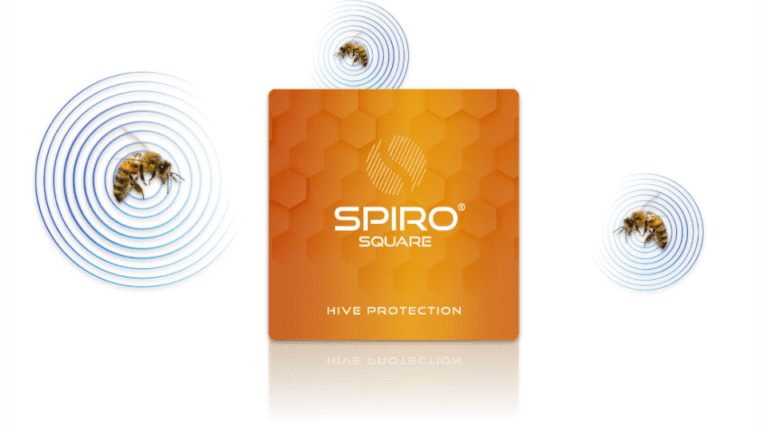
- Working within the NOXTAK® ecosystem to introduce SPIRO® Technology for hive protection
- Protecting hives from artificial EMF while preserving Schumann Resonance exposure
- Ensuring apiary monitoring systems continue operating at peak performance
The Electromagnetic Paradox: Why Complete Shielding Fails
The obvious response to electromagnetic harm is electromagnetic shielding. For bees, early observations suggest it may be the wrong answer.
The Favre-Johansson observations point to a possible paradox: artificial EMF may harm bees through disorientation and behavioral disruption, while heavy electromagnetic shielding may also cause harm by cutting colonies off from the Schumann Resonance of the Earth, the natural low-frequency field near 7.83 Hz.
In a long-running observation of two partially shielded hives, Favre and Johansson (2025) reported queen reproductive failure that stopped after a Schumann-frequency generator was added. The study had no concurrent controls, and the authors call for controlled replication.
If confirmed, this finding reframes the protection challenge. The goal is not to eliminate electromagnetic exposure. It is to filter artificial fields while preserving natural ones: selective management, not total exclusion.
Artificial EMF Exposure
Wireless infrastructure, power lines, and electronic devices generate artificial fields that may disrupt magnetoreception and the waggle dance, and have been proposed as a factor in CCD.
Schumann Resonance (7.83 Hz)
Researchers propose that this natural electromagnetic frequency plays a role in biological regulation. Early observations in shielded hives suggest its absence may impair reproduction.
Selective Filtering, Not Total Shielding
Reduce artificial EMF load around hives while maintaining the colony's connection to Earth's natural electromagnetic environment. SPIRO® Technology is designed for this specific requirement.
SPIRO® Technology in Apiary Protection
SPIRO® (Spin Radiation Organizer) is an advanced EMF management technology developed by NOXTAK®, the parent corporation whose ecosystem includes EFEIA Foundation, SPIRO®, and GEMS Academy. In the context of apiary protection, SPIRO® is designed to address the specific challenge the paradox describes: reducing artificial EMF exposure without eliminating the natural electromagnetic environment bees require.
Unlike conventional shielding, SPIRO® Technology is designed to reorganize the spin characteristics of incident radiation rather than block all electromagnetic input, so that the colony keeps access to the natural Schumann and geomagnetic fields. Independent testing of SPIRO® in apiaries has not yet been published.
Reduces Artificial EMF Exposure Around Beehives
Designed to lower the artificial electromagnetic load in the hive environment without requiring physical relocation of the apiary.
Preserves Connection to Natural Electromagnetic Environment
Designed to keep colony access to Schumann Resonance and the geomagnetic field, unlike total shielding.
Supports Apiary Monitoring Systems
Electronic hive monitoring and management systems continue operating at peak performance alongside SPIRO® deployment.

EFEIA Foundation operates within the NOXTAK® ecosystem alongside SPIRO® and GEMS Academy. NOXTAK® is the parent corporation: the source of the scientific and technological framework that EFEIA applies to research, standards, and certification work.
Contact EFEIA About SPIRO®Support the Bees. Reduce the Load.
If you are a farmer, beekeeper, or organization that wants to act on behalf of bee health, there are concrete steps available. EFEIA can help you assess electromagnetic conditions in your apiary, implement protective strategies, and connect with the broader network working on this problem.
Additional Scientific Resources
Selected literature on bee vitality assessment, digital monitoring, and colony health research.