
You can put your phone in airplane mode. You can ground yourself barefoot on grass. You can choose wired connections, manage your light after sunset, move your workstation away from the electrical panel. All of it works. All of it is backed by peer-reviewed evidence.
But none of it changes the electromagnetic profile of a building you don’t own.
You cannot rewire your office. You cannot verify whether a hotel room’s grounding resistance is 10 Ω or 0.8 Ω. You cannot audit the radiofrequency load in your child’s classroom or measure the dirty electricity riding on hospital wiring while you recover from surgery.
The moment you enter a space managed by someone else, your personal practice meets a structural ceiling. That space’s electromagnetic profile was locked in by decisions made during design, construction, and equipment procurement. Your habits modulate your exposure within that baseline. They cannot change the baseline itself.
For the spaces where people spend the most vulnerable hours, a different set of questions applies. Does this space meet a verifiable standard? Who measured it? Against what criteria? Using what methodology?
These questions are unanswerable today within any mainstream building certification framework. This article shows what it looks like when they get answered.
What an evaluated building looks like (and what an unevaluated one hides)
Take two hotels. Both hold wellness certifications. Both market themselves as places where guests recover, sleep deeply, and restore their health. Both have been certified for air quality, thermal comfort, lighting, and materials.
In the first hotel, a licensed consultant walked every floor with calibrated instrumentation. The grounding resistance of the electrical system was measured at 3.2 Ω and documented. The dirty electricity on the wiring was profiled: 85 mV average, with two spike sources traced to the kitchen’s inverter-driven equipment and resolved with targeted filtration. The RF environment in guest rooms was mapped: three access points were repositioned to increase distance from beds, and the building management system now powers down non-essential wireless infrastructure between 10 PM and 6 AM. The lighting in rooms was assessed for flicker rate and spectral composition. Natural light integration was measured. Every finding was scored against published thresholds, documented in a report, and independently verified.
In the second hotel, nobody asked any of those questions. The WiFi access points were installed where the IT contractor found it convenient. The electrical grounding meets code but has never been measured against biological reference values. The lighting was selected for aesthetics. The wiring carries whatever transients the building’s equipment generates. The electromagnetic environment of every guest room is unknown.
Both hotels have a certification plaque on the wall. One of them has an EHC Seal. The other has a blind spot where the electromagnetic dimension should be.
That distinction is what BEMCP (Bio-Compatible Electromagnetic Compliance Program) creates.
The gap that made BEMCP necessary
WELL, LEED, BREEAM, Fitwel, and RESET collectively certify more than 300,000 buildings across 186+ countries. Between them, they evaluate air quality, water quality, thermal comfort, acoustics, lighting, materials, nourishment, movement, and community. Nine dimensions of indoor environmental quality. Mature programs. Institutional science. Serious funding.
The electromagnetic environment is not a dimension they haven’t gotten to yet. It is one they evaluated and removed.
WELL v1 included Feature 78, requiring workstations to sit at least 3 meters from high-amperage wiring. Basic. Limited to one field type. But it existed. WELL v2 removed it entirely. The most adopted healthy building standard moved backward while IARC flagged RF-EMF re-evaluation as high priority and a US Court of Appeals ruled that the FCC had failed to adequately address non-thermal biological evidence.
BEMCP was developed by the EFEIA Foundation to fill that specific gap. Not to compete with existing certifications. To complete them.
Inside an evaluation: seven questions a consultant actually answers
A BEMCP evaluation is not a single measurement. It is a structured assessment across seven categories, each requiring different instrumentation, different expertise, and different thresholds. Here is what a licensed consultant actually does in a space.
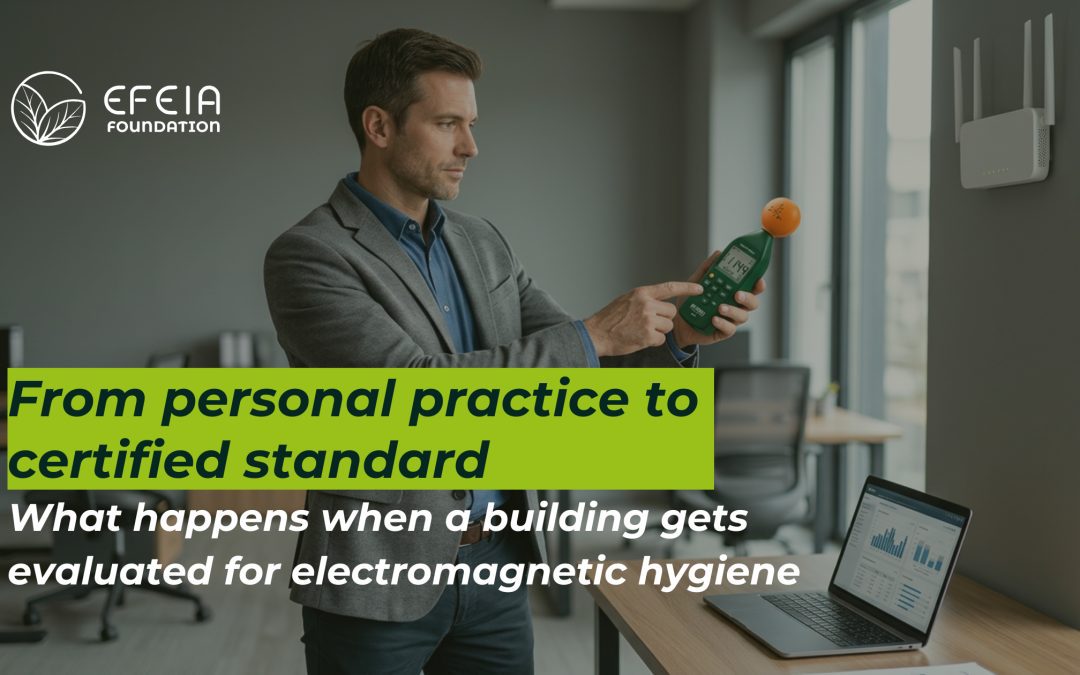
They start at the electrical foundation. Before anyone measures a WiFi signal, the consultant connects to the building’s grounding system. A ground resistance meter gives the first number. Above 10 Ω, the entire building structure acts as a low-frequency antenna — occupants accumulate alternating body voltage from the building itself. The consultant measures body voltage on a person standing in the space. Values between 2 and 5 V are common in buildings with poor grounding. Below 1 Ω, those voltages drop significantly. This single measurement determines the electromagnetic floor that everything else sits on.
They listen to the wiring. An oscilloscope connected to the electrical system reveals the dirty electricity profile: high-frequency transients riding on the 50/60 Hz power line. The consultant documents the average millivolt level and identifies spike sources. A dimmer switch in the conference room. A bank of cheap LED drivers in the corridor. The solar inverter on the roof feeding harmonics back into the building. Each source is documented, and the reduction pathway — filtration, replacement, or circuit isolation — is specified. Entry-level threshold: below 200 mV average. The tightest standard documented in the literature: below 20 mV with no peaks above 30 mV.
They map the radiofrequency environment. A spectrum analyzer surveys the space across all relevant frequency bands. WiFi access points, cellular signals from outside, Bluetooth beacons, IoT sensors, smart meters, DECT phones — each source is identified, located, and its contribution to the cumulative RF load quantified. ICNIRP’s limit is 10 W/m². The SBM-2015 “no anomaly” threshold for sleeping areas is 100 million times lower. BEMCP does not pick one number. It scores across a progression of verified reductions.
They evaluate the spatial design. This is LEDNA (Low Emission Design Near Field Awareness) in practice. How far are the beds from the electrical panel? Are workstations positioned adjacent to high-emission infrastructure? Was wired connectivity specified in the original design, or was WiFi the default because nobody asked? LEDNA is a design philosophy that asks whether the space was built to minimize unnecessary exposure from the beginning. The milestones scale from basic spatial awareness in rest areas to complete electrical field isolation with distancing protocols for all occupancy zones.
They assess what the radiation carries beyond its classical properties. This is the Artificial Quantum Noise dimension — the quantum noise component of man-made fields that classical instruments do not capture. Living systems run quantum processes (electron tunneling, radical pair mechanisms, spin coherence). Artificial radiation carries quantum noise that natural fields do not. Evaluation at this level uses specialized depolarization assessment and, at the highest tiers, environmental bioelectrography and biophysical wellbeing metrics. AQN reduction is achieved through technologies that neutralize the quantum noise without attenuating signal transmission.
They audit the light and the air together. Flicker rate. Spectral composition. Color temperature profile across the day. Natural light percentage. And alongside it: CO₂ levels, PM2.5, TVOCs, material toxicity, humidity. The EUROPAEM guidelines (2016) identified combined electromagnetic and chemical sensitivity as a clinical presentation. The consultant measures both because the occupant’s body experiences both.
They document how they measured everything. The methodology itself is scored. What instruments were used. How they were calibrated. Whether the assessment was a spot reading or a time-weighted dynamic profile. Whether heat mapping was performed. Whether the results are reproducible by another consultant with the same instrumentation. EFEIA’s proprietary IAS Method defines the baseline. The highest tiers require biophysical verification that measured improvements translate to measurable occupant outcomes.
Seven categories. Each scored across five milestones worth 1 point each. Maximum: 35 points, plus up to 3 bonus points from education programs (staff awareness training, periodic sessions, an active electromagnetic hygiene working group). The first 14 points must come from standard milestones — bonus points can only bridge the final stretch to Platinum.
What the score means
The scoring resolves into the EHC Seal (Electromagnetic Hygiene Compliance) at one of five tiers.
Bronze (≥7 points) is where most buildings land after their first evaluation and remediation cycle. The primary sources have been identified, measured, and reduced to documented baselines. For most buildings, this already represents more electromagnetic assessment than any other certification has ever required of them.
Silver (≥14) means the reductions are active and verified across all seven categories. This is where electromagnetic hygiene stops being a report and starts being a measurable condition of the space. Most commercial buildings pursuing certification for competitive positioning target Silver.
Gold (≥21) is the recommended minimum for healthcare environments, wellness facilities serving sensitive populations, and any context where occupant vulnerability is elevated. The American Academy of Pediatrics and EUROPAEM have both issued calls for reduced EMF exposure in clinical settings. Gold answers those calls with a scored, verified framework.
Diamond (≥28) requires that LEDNA was integrated from the design phase. This is not a tier you remediate your way into. It is a tier you design your way into. The cost difference is significant: specifying electromagnetic hygiene in the architectural brief is a line item; retrofitting it into a finished building means opening walls. Diamond rewards the decision to get it right the first time.
Platinum (33–35) is full compliance with ongoing monitoring and maintenance protocols. Continuous verification, not a biennial snapshot. The reference standard for the field.
No tier is self-declared. Each requires independent assessment by a licensed BEMCP consultant. The EHC Seal is valid for two years. Recertification is mandatory.
The question building owners will hear next
Three forces are converging.
The regulatory trajectory is precautionary. France restricted WiFi in schools. IARC has flagged RF-EMF re-evaluation as high priority. The US Court of Appeals ruled in 2021 that the FCC’s failure to address non-thermal evidence was “arbitrary and capricious.” The direction is clear even if the timeline is not.
The market trajectory is wellness. $548.4 billion in wellness real estate, projected to reach $1.1 trillion by 2029. 108% TRevPAR premium for wellness hotels. 26% cognitive performance gains in certified healthy buildings. The premium is real and growing. The buyers and tenants paying it are increasingly informed.
The awareness trajectory is exponential. The EMF personal protection market grows at 15% annually. The conversation has moved from fringe forums to mainstream health media. People who research air quality scores and LEED ratings are beginning to ask the same questions about the electromagnetic environment.
These trajectories intersect at a single point: a specific building where someone asks a question that no current plaque on the wall can answer.
What are the electromagnetic conditions in this space? Who measured them? Against what standard?
BEMCP exists so that question has an answer. The EFEIA Foundation built the standard. GEMS Academy trains the consultants who conduct the evaluations. The EHS Global Census (537 participants, 20+ countries) provides the population data that refines the criteria. 35+ licensed professionals operate across 10+ countries.
The electromagnetic environment has never been part of building certification. The framework to change that is operational. The process begins with a space assessment at efeia.org.