
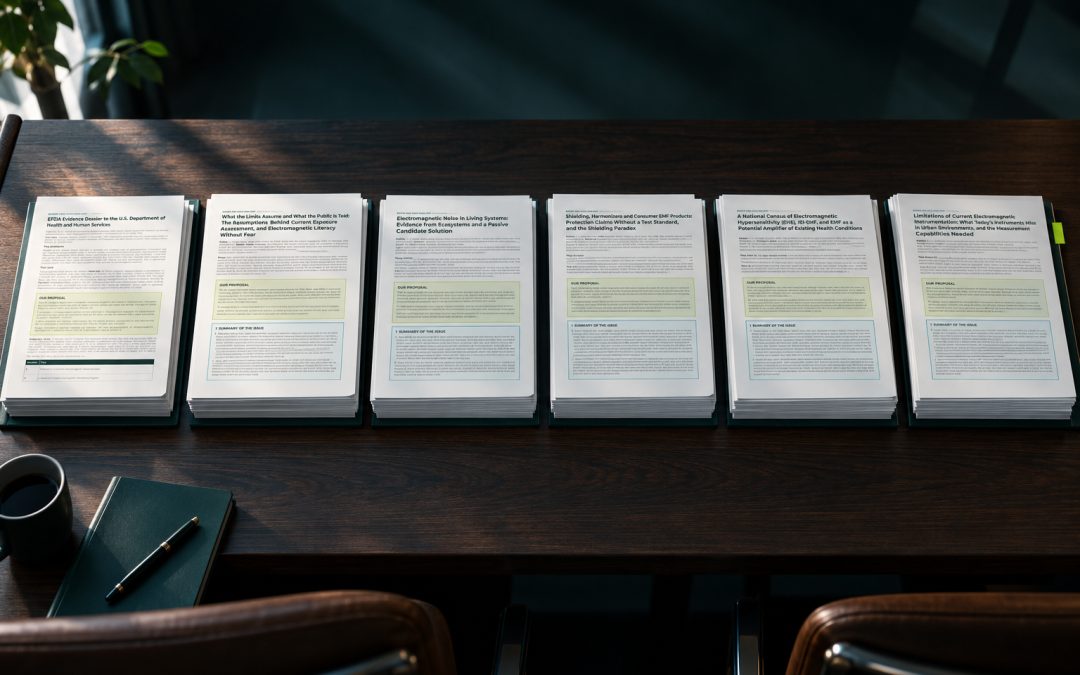
Eleven documents, each with its own DOI, now carry EFEIA’s evidence and proposals on electromagnetic exposure into the federal public record.
This October the EFEIA Institute reached a milestone. In response to the Request for Information from the U.S. Department of Health and Human Services (HHS) on electromagnetic fields, radiofrequency radiation and wireless exposure, we submitted eleven documents: six sections that form the core of our response, and five that go deeper into specific questions. Each is open access, carries its own DOI and is now part of the public record.
Together they place in that record EFEIA’s field measurements in Brickell (2020 to 2026) and Doral (2022), evidence reviews, proposals for national programs, and letters from two physicians.
One position guides EFEIA’s work: meeting regulatory limits does not mean exposure is under control. The limits do not consider the artificial polarization of waves or non-thermal effects, nor today’s multiple layers of exposure, our dependence on wireless connectivity, or how close and how long personal devices are used, including during sleep.
In brief
- The federal limits were built to prevent tissue heating. We ask HHS to review the assumptions behind them, one by one.
- Today’s instruments miss parts of real exposure: bands above about 6 GHz, low levels and brief peaks. The 2 to 150 kHz range has no exposure metric.
- In Brickell, Miami, measured levels rose between 2024 and 2026 while staying well below FCC limits. No federal program tracks this over time.
- People who report symptoms should be heard and characterized before anyone draws conclusions.
- Shielding that weakens a phone’s link can make it transmit harder, and bees and birds respond to fields far below the limits set for people.
- Each proposal names the agencies that could take part. None claims a mandate or an endorsement.
What HHS asked, and why we answered
HHS’s Office of the Assistant Secretary for Health (OASH) filed its Request for Information (RFI) on 17 September 2026. The Federal Register published it on 21 September (91 FR 59792, document 2026-19252) under docket HHS-OASH-2026-0397, and comments closed on 21 October.
HHS sought evidence to assess current knowledge, compare standards and identify research gaps, with particular attention to children and other potentially vulnerable populations. Its questions run from effects below federal limits to real-world exposure measurement, health surveillance and environmental effects.
We answered because many of those questions call for data the country does not yet collect, and to which EFEIA can contribute its field experience: exposure measured by place, source and time; methods that capture what current instruments miss; and a systematic characterization of the people who report symptoms.
We submitted nine documents on 20 October and two on 21 October. They sit in the public record alongside the other comments received, 7,081 according to the Federal Register page consulted on 22 October. HHS has said it will not respond to individual comments.
How to read these documents
In the six sections and Additional documents 4 and 5, every cited source carries an evidence grade, and no source moves up a grade through paraphrase. We use three:
- (a) peer-reviewed article, standards body, court record or accredited laboratory report.
- (b) institutional report, preprint, thesis or recognized seal.
- (c) manufacturer, advocacy or media source.
Our own unpublished field reports and census data are graded (b) and labeled as exploratory and not peer-reviewed; the author’s peer-reviewed papers keep grade (a), with the relationship stated. Manufacturers’ technical documents are graded (c), even when filed as exhibits.
We keep what was observed apart from what we propose as a hypothesis, and we say what we do not claim: Section 1, for example, states that EFEIA has not developed or validated a new instrument.
Each section opens with a summary and a box stating our proposal. The boxes below are quoted as filed.
Disclosure. EFEIA operates within the NOXTAK Corporation ecosystem. J. Joaquín Machado, the author or co-author of these documents, is EFEIA’s Founder and Director and also NOXTAK’s founder and CTO. NOXTAK develops and markets the passive nanocomposite that only Section 5 presents as a candidate solution (Section 4 and Additional 4 also cite its test results), on the terms Section 4 applies to every product: what was tested, by whom, under what standard, with what result, and what remains to be done. Sections 1 to 4 and 6 stand on their own; none depends on Section 5.
What the exposure limits assume
From Section 6, What the Limits Assume and What the Public Is Told. doi.org/10.5281/zenodo.23523497
The FCC limits (47 CFR 1.1310, adopted in 1996), ICNIRP 2020 and IEEE C95.1-2019 are designed to prevent tissue heating and, at low frequencies, nerve stimulation. According to ICBE-EMF, they derive from 1980s studies in which 5 monkeys and 8 rats were exposed for 40 to 60 minutes: an apparent threshold of 4 W/kg, divided by 50, gives the public limit of 0.08 W/kg.
The FCC averages exposure over up to 30 minutes and sets no limit for brief pulses. Peaks, modulation, polarization, simultaneous sources and a phone beside the bed all night go unmeasured. In ANFR test data for 450 phones, most would exceed the ICNIRP limit 1.6 to 3.7 times when held against the body.
Federal information for the public is thin, and EFEIA found no evaluation of any U.S. exposure message for comprehension, behavior or anxiety. Fear is also a risk: an alarming television report raised symptom reports after sham Wi-Fi exposure among anxious viewers.
| Our proposal EFEIA proposes that HHS review, one by one, the assumptions on which the FCC and ICNIRP exposure limits rest, starting with the fourteen identified by ICBE-EMF and set out in J. Joaquín Machado’s Electromagnetic Pollution book, state which of them current evidence still supports, and send that assessment to the FCC for the remand record.Where an assumption does not hold, the test or limit built on it should change: device testing at body contact and with child and pregnant anatomical models, limits for brief pulses, assessment of combined exposures, and protection for workers and pregnant women.To carry this into practice, EFEIA proposes a four-stage National Program for Scientific Integration and Professional Education on Electromagnetic Exposure and Health, convened by HHS: evidence synthesis, consensus review of the assessment criteria, university and continuing education, and public guidance tested for comprehension and effects on anxiety before release, so that it builds competence without fear (Exhibit 6A). |
What today’s instruments cannot see
From Section 1, Limitations of Current Electromagnetic Instrumentation. doi.org/10.5281/zenodo.23523487
Every exposure figure inherits the limits of the instrument that produced it. Personal exposimeters measure a fixed list of bands up to about 6 GHz. A broadband probe that reaches 90 GHz cannot detect fields below 0.7 V/m, the order of the median measured across New York City.
Values below an instrument’s floor become zero, values above its ceiling are clipped, peaks are averaged away, and neither modulation nor polarization is recorded. The 2 to 150 kHz range has no exposure metric at all. At the same site, broadband and frequency-selective instruments differed by up to 12.28 dB, against the ±3 dB uncertainty most studies state.
A value below the limit shows distance from a heating threshold; it does not show that the exposure has been characterized or is under control. Exhibit 1A is a 24-month development plan, not a validated instrument.
| Our proposal EFEIA proposes to define the measurement requirements that radiofrequency and microwave instruments must meet in urban environments, and to evaluate, with NIST and accredited laboratories, which current instruments meet them.From that evaluation, instruments and methods should be developed or adapted, validated in the field and turned into a measurement and reporting standard that can be applied nationwide. |
Measuring a city over time: Brickell and Doral
From Section 2, National Urban Electromagnetic Monitoring Program. doi.org/10.5281/zenodo.23523489
No federal program measures ambient radiofrequency exposure over time, and the last national survey of 50/60 Hz fields dates from 1998.
In Brickell, Miami, between July 2024 and September 2026, our maximum-hold surveys recorded a 12.4% rise in the median, 70.1% in the 95th percentile and 57.8% in the maximum, and signals at 24 to 40 GHz went from not detected to detected. Every value is well below the FCC limits, and they still rose. These are our own exploratory data, graded (b).
In Doral, Florida, in 2022, spot maxima of the magnetic field reached 3.11 µT at a substation and 2.76 µT in a public dog park; no causal or compliance conclusion is drawn from them. Separately, residents have asked EFEIA about telecommunications infrastructure, especially 5G, and at those same addresses its measurements also found distribution lines, transformers and building wiring: one assessment has to cover both kinds of field.
| Our proposal EFEIA proposes to establish, in collaboration with the competent federal authorities, an independent national electromagnetic monitoring program for urban environments that covers both the radiofrequency and microwave fields of telecommunications and the low-frequency electric and magnetic fields associated with urban electrical infrastructure, with Brickell, Miami (2020-2026), and Doral, Florida (2022), as reference cases.The program should include standardized measurement procedures for each type of exposure, continuous sensors, repeated measurement routes, periodic assessments, identification of priority areas such as schools, childcare centers and health-care facilities, and reproducible protocols that can be implemented nationwide; it should publish open data and begin with a 12-month pilot in Miami and two to four other U.S. cities. |
Listening before concluding
From Section 3, A National Census of EHS, and EMF as a Potential Amplifier of Existing Health Conditions. doi.org/10.5281/zenodo.23523491
WHO recognizes that the symptoms of electromagnetic hypersensitivity (EHS, IEI-EMF) are real and can be disabling, and states that there is no scientific basis to link them to exposure. In the United States there is no diagnostic pathway, no HHS guidance and no systematic data. EFEIA recognizes this suffering without asserting a causation that has not been consistently shown.
In the 2025 EHS Global Census, among the 94 participants who completed all three questionnaires, symptoms correlated more with sleep disruption (r = 0.638) than with exposure habits (r = 0.413). The section sets that observation apart from the hypothesis it raises and from the study needed to test it.
Questionnaire A records technology habits, proximity and night-time device practices; questionnaire B rates 25 symptoms from 0 to 10. Neither is validated yet: before any clinical use, each must show reliability, sensitivity and specificity. Exhibit 3A, a 2022 school case in Doral with 15 student questionnaires, does not identify which source, if any, caused the reported symptoms.
| Our proposal: National Program for the Characterization of Electromagnetic Hypersensitivity EFEIA proposes to develop a national program for the systematic collection and analysis of information on people who report symptoms attributed to electromagnetic exposure, taking as its starting point its field experience and the assessment instruments it has developed over the years.The program would apply questionnaires A and B in a standardized way, to collect information on technology-use habits, symptoms and patterns of perceived exposure.Its aim would be a structured body of information that helps characterize the participating population, identify patterns that require further research and support the design of future scientific and clinical studies.The program is conceived as a characterization and research initiative, not as a diagnostic test or a procedure that can by itself establish the cause of the symptoms. |
When protection adds exposure
From Section 4, Shielding, Harmonizers and Consumer EMF Products. doi.org/10.5281/zenodo.23523493
Shielding is rated on flat material samples in laboratory fixtures, not in occupied homes, and it carries a paradox. Under 3GPP power control, a phone raises its uplink power as its link weakens, up to 23 dBm (200 mW) for LTE and 5G NR phones of Power Class 3. Blocking a weak, distant signal can increase the strongest exposure a person receives: the one from their own phone.
The FCC and the FTC both warn that shielded phone cases and phone “shields” can have this effect, and under weak reception, exposure from 2G phones on four U.S. networks was up to four orders of magnitude higher than under strong reception.
No U.S. statute, regulation or consensus standard defines “EMF protection” or says how such a claim must be tested, and some products add exposure: the Dutch nuclear regulator found ten wearables, among them an “anti-5G” pendant, emitting ionizing radiation, and the NRC reports uranium and thorium above licensing levels in wristbands and pendants.
| Our proposal EFEIA proposes that HHS lead, with NIST, the FTC and the FCC, a National Framework for the Evaluation and Regulation of Electromagnetic Protection Technologies: every product sold as protection is classed by the function it claims, tested for physical performance, for effects on its surroundings and on communications and, where health is claimed, for that benefit, and recognized only for what was verified (Exhibit 4A).For shielding, the test should measure what a person receives before and after installation, including the person’s own phone, which transmits harder when its link to the network weakens.An independent survey of marketed products in accredited laboratories, with published data, should inform consumer guidance that starts with distance and source control. |
Bees, birds and electromagnetic noise
From Section 5, Electromagnetic Noise in Living Systems. doi.org/10.5281/zenodo.23523495
Migratory birds and honey bees respond to fields far below the limits set for people. Weak broadband radiofrequency noise, about 1,000 times weaker than current recommended limits according to a BfS workshop review, disrupts the magnetic compass of migratory songbirds.
In honey bees, olfactory learning was 73% in controls and 63% under a 50 Hz field of 20 µT. More than three quarters of the leading types of global food crops rely to some extent on animal pollination; measured by volume rather than by type of crop, 5% to 8% of global crop production is directly attributable to it (IPBES). EFEIA has identified no federal exposure limit for animals.
EFEIA proposes to treat that broadband noise as a property to measure and manage in its own right, and calls the disturbance it addresses Artificial Quantum Noise (AQN), a proposed model kept apart from what instruments record.
The section then presents a candidate solution: a passive nanocomposite, with no power supply or transmitter, that does not attenuate the signal. NOXTAK develops and markets it as SPIRO®; the author is NOXTAK’s founder and CTO and the named inventor on its patents, and NOXTAK entities were the applicant or client for the laboratory reports. The evidence is set out in six tiers, each with its grade.
In independent, accredited laboratories (Morlab, FCC-recognized, and Verkotan, FINAS-accredited), the nanocomposite produced up to 91% reduction in 10 g-averaged SAR across seven configurations, with antenna performance unchanged within uncertainty on three handsets, grade (a). A university-led, open, randomized, placebo-controlled trial with 50 healthy participants (25 per group) recorded changes in heart rate variability in the active group over 30 days, grade (a). The developer’s field records are uncontrolled before-and-after comparisons, grade (c).
The section states what is still missing: a test standard for non-attenuating products, data on 5G NR devices, a blinded sham-controlled trial, and a test of the link between the noise that disrupts the bird compass and the developer’s proposed model (AQN). The ecosystem evidence comes from independent research and does not depend on the nanocomposite.
| Our proposal EFEIA proposes that HHS include passive, non-shielding approaches in the research it asks about in question 5(o), with this nanocomposite as the first worked case: a paired test of absorbed dose (SAR) and antenna performance on current 4G and 5G devices in accredited laboratories, controlled trials in homes and workplaces that separate the nanocomposite from other measures, and a sham-controlled physiological trial.EFEIA also proposes that HHS treat effects on pollinators, migratory birds and livestock under question 14, through a field program led by NIEHS with the Department of the Interior, USDA and EPA (apiary trial, stopover noise surveys, farm surveys), in which the nanocomposite is tested in its own arm, analyzed separately.EFEIA invites a technical discussion with HHS and its agencies on the underlying reports, measurement records, material documentation and replication conditions: how far the observed outcomes reach, the conditions under which they recur, and the further tests needed to establish mechanism, generalizability and biological relevance. |
Five documents that go deeper
These go deeper into questions the sections open. None claims that exposure has been shown to cause the conditions it examines; each states what remains to be studied.
Havana syndrome, catastrophic tinnitus and extreme EHS
Additional document 1, working paper. doi.org/10.5281/zenodo.23522254
This working paper is by Dr. Luis M. Valdés, physician, audiologist and certified tinnitus specialist, and J. Joaquín Machado. It cites the National Academies’ 2020 conclusion that directed, pulsed radiofrequency energy appears to be the most plausible mechanism for the acute phase of Havana syndrome. As a hypothesis, it proposes that Havana syndrome, catastrophic tinnitus and extreme EHS share a common final mechanism: a phenomenological convergence, not a proven etiological equivalence. It lists what is established apart from what the authors propose, notes that the mechanism remains under scientific debate, and sets out five research lines, including urban dosimetry near schools and substations.
Bluetooth earbuds and teenage tinnitus
Additional document 2, SPECTRA evidence review. doi.org/10.5281/zenodo.23519286
This SPECTRA evidence review does not ask whether Bluetooth causes tinnitus, because no human study has tested that. It describes a new exposure: low-level, continuous for hours, bilateral and 20 to 30 mm from the cochlea, while the available epidemiological studies measured phone-to-ear call time instead. It sets seven research priorities, among them a cohort of 2,000 adolescents aged 12 to 15 with both acoustic and radiofrequency dosimetry. Its conclusion: neither “earbuds cause tinnitus” nor “earbuds are proven safe with respect to tinnitus” is supported, because the relevant study has not been done.
Electromagnetic fields and autism
Additional document 3, SPECTRA evidence review. doi.org/10.5281/zenodo.23519237
The second SPECTRA review does not ask whether electromagnetic fields cause autism: the human evidence for that does not exist, and the review says so. It asks whether they act as an environmental stressor on autistic people, as noise or sleep loss do. Mechanisms converge most on oxidative stress, cortical excitability and sleep, and no study has tested this in autistic people. Until that is tested, it frames electromagnetic fields as a candidate stressor: plausible on mechanism, unproven in the population and modifiable at low cost.
The car as an occupied electromagnetic environment
Additional document 4, summary and national plan. Summary: doi.org/10.5281/zenodo.23541753. Plan: doi.org/10.5281/zenodo.23541733
A vehicle cabin combines low-frequency fields from batteries and inverters with Wi-Fi, Bluetooth and radars at 57 to 64 GHz (cabin) and 76 to 81 GHz (road), while the in-vehicle radiofrequency surveys the document cites stop at 6 GHz. No U.S. rule requires anyone to assess what reaches the occupant from all sources together. The national plan proposes, over 24 months, a whole-cabin protocol, occupant dosimetry that includes children, pregnant occupants and professional drivers, and a consented symptom registry. Its disclosure notes that one cited study, by the author, evaluates the candidate solution in Section 5.
Rethinking how EHS research is designed
Additional document 5, national program filed with three letters. doi.org/10.5281/zenodo.23545803
The proposal accepts the existing record: reviews of blinded provocation studies found no robust evidence that exposure triggers the symptoms. It argues that those studies answered a narrower question; in one review of 28 studies, 82% showed selection bias. It does not ask anyone to set aside negative findings or to declare causation. It proposes a 24-month program with revised research criteria, a clinical pathway with professional training, a consented clinical registry with tinnitus and sound intolerance as defined outcomes, and a blinded replication of the biomarkers reported to date. Letters from J. Joaquín Machado, Dr. Pilar Muñoz-Calero, President of Fundación Alborada (Madrid), and Dr. Luis M. Valdés accompany it.
The proposals, and who would take part
Six of the eleven documents propose a national program or framework; Section 1 adds an instrument development plan and Section 5 a field program. The table shows what each addresses, which agencies the document names, and its timeframe.
| Proposal | What it addresses | Agencies the document names | Timeframe |
|---|---|---|---|
| National Program for Scientific Integration and Professional Education (Section 6, Exhibit 6A) | Limits built on heating alone, and public messages with no published evaluation | HHS as convener; Section 6 adds FDA (CDRH), NIEHS and CDC | Four stages, as a continuing national capability |
| Next Generation Electromagnetic Measurement Instruments: Engineering Development and Validation Plan (Section 1, Exhibit 1A) | Instruments that miss bands above about 6 GHz, low levels, peaks and 2 to 150 kHz | Section 1 names NIST and accredited laboratories and, along its path, EPA, NIEHS, NTIA ITS, the FCC and standards bodies; Exhibit 1A names no agency | 24-month development horizon; Section 1’s path to a standard runs to year 3. A development plan, not a national program |
| National Urban Electromagnetic Monitoring Program (Section 2, Exhibit 2B) | No federal program measures ambient exposure over time | HHS through OASH, with NIEHS, EPA, NIST, NTIA ITS and the FCC (Section 2 summary; Exhibit 2B assigns no agency) | 12-month pilot in Miami and two to four other cities; 24-month initial cycle in Exhibit 2B |
| National Program for the Characterization of Electromagnetic Hypersensitivity (Section 3, Exhibit 3B) | No systematic data on people who report symptoms | HHS through OASH, with NIEHS, CDC, universities and community partners | 24 months |
| National Framework for the Evaluation and Regulation of Electromagnetic Protection Technologies (Section 4, Exhibit 4A) | Protection products with no definition or test method | HHS with NIST, the FTC and the FCC; Section 4 adds the CPSC | None set |
| Ecosystem field program (Section 5) | No federal exposure limits or monitoring for animals | NIEHS with the Department of the Interior, USDA and EPA; Section 5 also names FDA’s Center for Veterinary Medicine for farm work | Several seasons at apiaries; not framed as a national program |
| National Plan for Electromagnetic Biocompatibility in Modern Vehicles (Additional 4) | No U.S. rule requires assessing what reaches the occupant from all sources together | HHS with DOT, NHTSA, the FCC, NIST and independent laboratories; the summary adds NIOSH, NIEHS, CDC and FDA (CDRH) | 24 months |
| National Program for the Review of Research Criteria in Electromagnetic Hypersensitivity (Additional 5) | Studies built for a narrower question than the conclusion drawn from them | OASH convenes; NIH (NIEHS and NIDCD), CDC, FDA (CDRH), NIST and university laboratories | 24 months |
These are roles EFEIA proposes. No document claims an existing mandate or an agency’s endorsement.
What comes next
The eleven documents are now part of the public record, and anyone can consult them through their DOIs. What we offer HHS and its agencies is technical collaboration: field experience, data, protocols, and the technical discussion that Section 5 proposes.
Over the coming weeks we will publish one piece per theme: what the limits leave out, how to measure what reaches the person, listening before concluding, what is known and what is missing about children and adolescents, and how to protect without creating another problem. Each links back to its section of this article.
If you research, measure, or care for people who are affected, write to us at in**@***ia.org. Every proposal here needs partners.
Read the documents
All were submitted to docket HHS-OASH-2026-0397 on Regulations.gov.
| Document submitted | Filed | DOI | Tracking number |
|---|---|---|---|
| Section 1. Limitations of Current Electromagnetic Instrumentation | 20 Oct 2026 | 10.5281/zenodo.23523487 | mvh-ld0k-7q4b |
| Section 2. National Urban Electromagnetic Monitoring Program | 20 Oct 2026 | 10.5281/zenodo.23523489 | mvh-ljln-7rkx |
| Section 3. A National Census of EHS, and EMF as a Potential Amplifier of Existing Health Conditions | 20 Oct 2026 | 10.5281/zenodo.23523491 | mvh-louw-o1qe |
| Section 4. Shielding, Harmonizers and Consumer EMF Products | 20 Oct 2026 | 10.5281/zenodo.23523493 | mvh-lvah-hryj |
| Section 5. Electromagnetic Noise in Living Systems | 20 Oct 2026 | 10.5281/zenodo.23523495 | mvh-m6a8-0wao |
| Section 6. What the Limits Assume and What the Public Is Told | 20 Oct 2026 | 10.5281/zenodo.23523497 | mvh-mbrm-91pn |
| Additional 1. Havana syndrome, catastrophic tinnitus and extreme EHS (Valdés and Machado) | 20 Oct 2026 | 10.5281/zenodo.23522254 | mvh-mhzp-mj83 |
| Additional 2. Bluetooth headphones and RF-EMF in teenage tinnitus | 20 Oct 2026 | 10.5281/zenodo.23519286 | mvh-mnzk-nr7e |
| Additional 3. Electromagnetic fields and autism spectrum disorder | 20 Oct 2026 | 10.5281/zenodo.23519237 | mvh-ms2y-2u6b |
| Additional 4. Modern vehicles as occupied electromagnetic environments | 21 Oct 2026 | 10.5281/zenodo.23541753 | mvi-ltyr-pc3o |
| Additional 5. National Program for the Review of Research Criteria in Electromagnetic Hypersensitivity | 21 Oct 2026 | 10.5281/zenodo.23545803 | mvi-lycs-glo8 |
Exhibits with their own DOI
- Section 1, Exhibit 1A: 10.5281/zenodo.23513482
- Section 2, Exhibits 2A, 2B and 2C: 10.5281/zenodo.23513490, 10.5281/zenodo.23513478, 10.5281/zenodo.23513464
- Section 3, Exhibits 3A and 3B: 10.5281/zenodo.23513500, 10.5281/zenodo.23513476
- Section 4, Exhibit 4A: 10.5281/zenodo.23513472
- Section 5, integrated technical statement: 10.5281/zenodo.23513484
- Section 6, Exhibit 6A: 10.5281/zenodo.23513425
- Additional 4, national plan: 10.5281/zenodo.23541733
About the EFEIA Institute. The EFEIA Institute (Electropollution-Free Environments International Accreditation Foundation) is a 501(c)(3) nonprofit in Miami, Florida, working on electromagnetic hygiene research, standards and certification. The eleven documents were authored or co-authored by J. Joaquín Machado, EMR Researcher and EFEIA Founder & Director, who is also the founder and CTO of NOXTAK Corporation. This article is published by EFEIA Communications.
Sources. Documents submitted by the EFEIA Institute to docket HHS-OASH-2026-0397 (DOIs under Read the documents). HHS, Office of the Assistant Secretary for Health. Request for Information on Electromagnetic Fields (EMFs), Radiofrequency (RF) Radiation, and Wireless Radiation Exposure. Federal Register 91 FR 59792, 21 September 2026. federalregister.gov/d/2026-19252.