
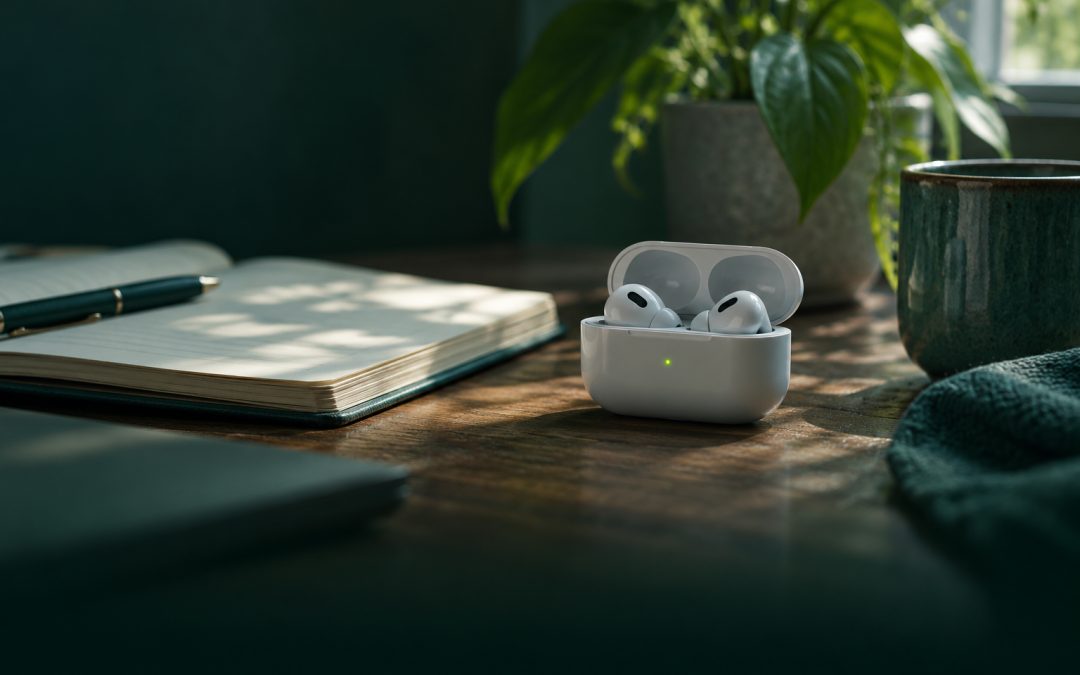
Wireless earbuds deliver sound and a radio signal at the same time, for hours, next to the inner ear. Our evidence review sorts what is known about each and sets out the research that would answer the open question.
EFEIA Communications · 6-minute read
True wireless stereo (TWS) earbuds sit in the ear canals, 20 to 30 mm from the cochlea, and deliver two exposures for as many hours a day as they stay in: sound, and a low-level radiofrequency electromagnetic field (RF-EMF). An international standard for safe listening covers the sound. It says nothing about the radio signal, which in that position and for that long has not been tested against tinnitus in humans.
That gap is the subject of Bluetooth Headphones and RF-EMF in Teenage Tinnitus, an evidence review by J. Joaquín Machado for EFEIA’s SPECTRA research program. It is one of the eleven documents the EFEIA Institute submitted in October to the U.S. Department of Health and Human Services (HHS) in response to its Request for Information on electromagnetic fields, radiofrequency radiation and wireless exposure, and it is now part of the public record. The review “does not ask whether Bluetooth causes tinnitus. No human study has tested that.” Throughout, it keeps three tiers apart: established, plausible and untested.
Tinnitus in young people: the answer depends on how you ask
Tinnitus, the perception of sound without an external source, affects roughly 14% of adults worldwide, about 740 million people, and severe tinnitus about 2%. Among children and teenagers, estimates run from 3.1% in a school screening of 43,064 children in Warsaw to 54.7% by questionnaire among adolescents in São Paulo, where tinnitus confirmed in a sound booth was about half that figure: 28.8%. The review attributes the spread more to case definition and ascertainment than to real differences. Whether tinnitus is becoming more common among teenagers has not been measured in a repeated population survey.
Teenage ears can also carry damage that a standard hearing test does not show. In mice, noise that caused only a temporary shift in hearing thresholds led to the permanent loss of up to half the synapses on the inner hair cells, a condition called “hidden hearing loss” because the audiogram does not see it. The review’s reading: “the teenage auditory periphery can carry substantial, invisible damage from acoustic dose alone.”
The established risk is sound
WHO estimates that over 1 billion young people are at risk of avoidable hearing loss from unsafe listening, and a systematic review of 33 studies places 24% of 12- to 34-year-olds in the unsafe range for personal listening devices alone. According to the review, adolescents accumulate synapse damage from personal listening “at doses that never produce a threshold shift.”
ITU-T H.870, developed with WHO, sets a weekly sound allowance: the equivalent of 80 dB(A) for 40 hours for adults, and 75 dB(A) for 40 hours for sensitive users, including children. Each 3 dB increase halves the time, so at 89 dB(A) the adult allowance runs out in 5 hours. Conforming devices track the cumulative dose and warn the user. The standard “contains no provision for the RF-EMF the same devices emit.”
For families, this is the part of the evidence that supports action today: how loud, and for how long. The review calls the acoustic side “established, quantified and regulated.”
The radio signal: a new exposure profile
Compared with a phone held to the head, the review describes earbud exposure as different on four counts: a dose one to two orders of magnitude lower, continuous for hours rather than minutes of calls, bilateral, and next to the cochlea. Two independent field studies estimate the specific absorption rate (SAR) of earbuds at roughly 0.006 to 0.017 W/kg, about 1% of the limit. Both derive it from field strength and appear in modest journals, so they “corroborate the low-dose reading without settling it.”
The human studies available measured phone calls. The COSMOS cohort, with 21,049 participants in Sweden and 3,120 in Finland and call time recorded by operators, found no association between call time and tinnitus or hearing loss; it recruited before true wireless earbuds existed. A 2024 WHO-commissioned review concluded that exposure below guideline values does not cause tinnitus, rating the evidence very low certainty. Both sides of the dispute over that review agree that every study it included measured phone call time.
Two small, acute studies of Bluetooth headsets found no significant short-term effect on hearing. No study has tested long-term earbud use against tinnitus, and no human study has separated the radio signal from the sound. Bluetooth hearing aids and cochlear implant processors, which use the same low-power radios with no reported adverse auditory effect, offer the most reassuring data, but their users are mostly older adults with existing hearing loss or people whose cochleae no longer function.
In the review’s words, the null finding “is accurate for the exposure it measured and silent on the exposure of interest.” The dosimetry shows that earbuds are not phones; it does not show that continuous bilateral exposure next to a developing cochlea is inert.
Sleep, the one reproducible signal
Sleep is the one physiological domain, the review says, in which radiofrequency exposure below heating levels has a reproducible human signal. In double-blind crossover studies, pulse-modulated exposure before sleep altered the sleep EEG, particularly spindle-frequency activity in non-REM sleep, although one large study found no consistent effect on sleep quality. The effect is small, its clinical meaning is unknown, and ICNIRP treats it as not established as harmful.
Sleep loss lowers the threshold for phantom sound and raises distress, and sleep disturbance is among the strongest correlates of teenage tinnitus. The review describes nighttime earbud use as growing among adolescents: it places a radio in both ear canals during hours when the acoustic dose would otherwise be zero. No study has examined nighttime earbud use, sleep and tinnitus together. The review calls this “a candidate mediating pathway, not a demonstrated one.”
Our proposal
We quote the review’s research agenda as filed (section 13.2): its seven priorities, trimmed where marked.
- A repeated teenage tinnitus surveillance series with a fixed case definition. Annual or biennial school-based surveys […] with wear time of in-ear wireless devices recorded from the first wave. […]
- A synaptic-count animal study under chronic RF-EMF with and without noise. Expose young rodents to 2.4 GHz Bluetooth-modulated RF at earbud-representative SAR for 8 hours daily over 8 weeks, with and without moderate noise, […]
- A prospective teenage cohort with dual dosimetry. Recruit 2,000 adolescents aged 12 to 15, fit in-ear acoustic dosimeters and worn RF exposimeters […] and pre-register tinnitus […] as outcomes at two and four years.
- A nighttime-earbud sleep study. Crossover design in adolescents who sleep with earbuds: active Bluetooth versus sham-paired devices, polysomnography with spindle analysis, and morning tinnitus rating.
- An RF annex to ITU-T H.870. Petition ITU-T Study Group 16 and WHO Make Listening Safe to add an RF-EMF characterization requirement for safe listening devices […]
- An exposome-first tinnitus registry. A clinical registry that records acoustic dose, personal-wireless wear time, ambient RF-EMF and susceptibility markers […]
- Independent Bluetooth earbud dosimetry. Peer-reviewed SAR and field-strength measurement of current TWS models in child and adolescent head phantoms […]
What this document does not claim
The review does not claim that earbuds cause tinnitus, nor that they are proven safe with respect to tinnitus. It finds the first statement unsupported and the second “equally unsupported, because the relevant study has not been done.” The radiofrequency hypothesis “remains untested in humans” and is presented “as a candidate mechanism, not as a demonstrated one.” The review is a narrative review with structured verification, not a systematic review, and its earbud SAR figures do not come from independent phantom dosimetry. It also names what would change its reading: results such as a positive animal synapse study would move it from precautionary monitoring to active advice, while null results from that study and from a well-powered earbud cohort would let the radiofrequency question be de-prioritized relative to the acoustic one, “which would remain the established target.”
Read the document
Bluetooth Headphones and RF-EMF in Teenage Tinnitus. Additional 2, a SPECTRA evidence review by J. Joaquín Machado, EMR Researcher and EFEIA Founder & Director, dated September 2026. https://doi.org/10.5281/zenodo.23519286
Filed on 20 October 2026 to docket HHS-OASH-2026-0397 on Regulations.gov. Tracking number: mvh-mnzk-nr7e.
All eleven documents, presented together: https://efeia.org/efeia-submission-to-the-hhs/
Disclosure. The EFEIA Institute operates within the NOXTAK Corporation ecosystem. J. Joaquín Machado, EMR Researcher and EFEIA Founder & Director, authored or co-authored the eleven documents and is also NOXTAK’s founder and CTO. This article is published by EFEIA Communications.