
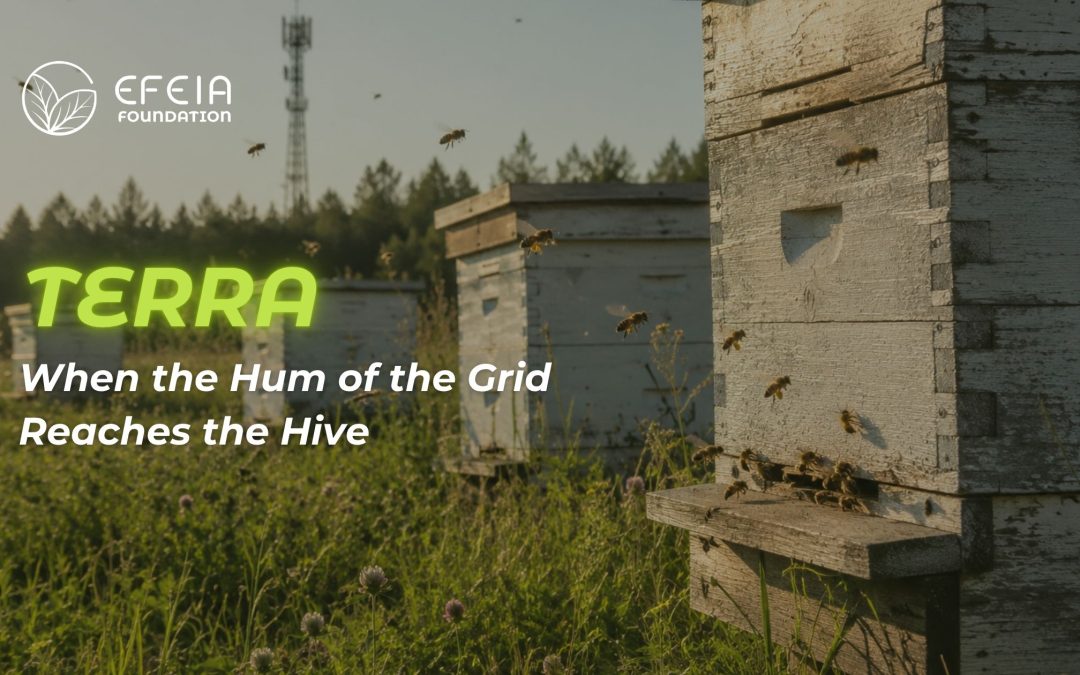
In Switzerland in 2010 and 2011, a researcher named Daniel Favre placed active mobile phones near five healthy beehives and recorded the sound the bees made. After roughly 25 to 40 minutes of exposure, the bees began to produce a distinctive vocalization called worker piping. In a hive, worker piping signals one of two things: an imminent swarm, or a serious disturbance. Favre’s bees were not preparing to swarm. They were stressed by something they could hear or sense and could not move away from. When the phones were switched off, the piping subsided.
Favre’s experiment is one observation, with one researcher, in five hives. It does not establish that mobile phones harm bees in any general way. The literature on EMF and pollinators is messier than that. What the observation does establish is that the question is not crazy. Bees can perceive things in our shared environment that humans treat as invisible, and some of those things are now in every garden, every farm, every patch of forest near a road. TERRA exists because ecosystems cannot move the router.
What this pillar covers
SPECTRA studies the human body under electromagnetic load. TERRA studies everything else alive that is exposed to the same load and has no say in the matter. The scope includes pollinators, soil microbiota, plants, livestock, birds, and the broader ecological function of natural systems near transmitters, power infrastructure, and dense wireless deployments.
The pillar exists for a structural reason that bears stating directly. Most regulation of EMF is built around adult human exposure, with safety thresholds derived from thermal effects in human-sized bodies. A honey bee is not a small human. Bee size relative to wavelength, bee tissue composition, and bee navigation through magnetoreception are all unlike anything in the human exposure model. A protocol designed around the human skull tells us nothing about what a cell tower does to a colony foraging within its range. Ecological systems require their own science, with their own endpoints, their own dose models, and their own threshold logic. TERRA is where that science gets done.
What the literature actually shows
The honest summary of ecological EMF research is that the signal exists, the evidence is heterogeneous, and the field is younger than it should be. Three reference points anchor what is known.
The most cited systematic review of ecological RF-EMF effects is Cucurachi and colleagues (2013) in Environment International. The review screened 113 peer-reviewed studies covering five species groups: birds, insects, other vertebrates, other organisms, and plants. In roughly 65% of the studies, a statistically significant effect of RF-EMF on ecologically relevant endpoints was reported, with effects appearing at both high and low dosages. The review found no clear dose-response relationship across the literature and pointed at a methodological problem: most of the work was conducted in laboratory settings, with limited standardization and limited field replication. The signal is real, the framework around it is underdeveloped.
For pollinators specifically, the 2019 review by Vanbergen and colleagues in Science of the Total Environment assessed the question more strictly. Their conclusion: laboratory experiments offer some evidence that honey bees and other invertebrates can detect electromagnetic radiation and may use that detection for orientation, but high-quality field-realistic studies are sparse, and whether anthropogenic EMF poses a meaningful threat to pollinator populations in the field remains an open question. The review identifies the gap rather than closing it.
For trees, the most rigorous field study is Waldmann-Selsam and colleagues (2016) in Science of the Total Environment. The team monitored tree damage in the German cities of Bamberg and Hallstadt from 2006 to 2015, taking measurements at 144 locations around mobile phone base stations. Damaged trees were concentrated on the side facing the antenna, in a pattern that correlated with measured field strength. The asymmetry is the part that resists easy explanation by other causes: a tree damaged by drought or pollution is damaged on all sides.
What these three reviews and studies share is a pattern that recurs across ecological EMF research. Effects are reported. The effects are often biologically plausible. Replication is limited. The studies that find effects and the studies that find no effects use different protocols, different exposure levels, different durations. The result is a literature that mainstream regulators read as inconclusive and that ecologists working close to the question read as concerning. Both readings have basis in the same evidence.
What the Census changed for TERRA
TERRA is younger than SPECTRA, and its flagship project is field-based rather than survey-based. The Apiary Protection Project is EFEIA’s active program for monitoring colony health in environments with characterized EMF exposure profiles. The point of the work is to do what most of the laboratory literature has not done: field-realistic exposure, controlled comparison, longitudinal monitoring, and standardized measurement of the endpoints that matter to colony survival.
The Apiary Protection methodology starts with mapping the electromagnetic environment around participating apiaries to a level of detail that the literature usually lacks. Power density across the relevant frequency bands. Distance to the nearest sources. Background levels at hive height. Variation across the day. The colony data then has a measured exposure history to be tested against, instead of a generic “near a tower / far from a tower” classification.
The project is in early stages. It will not produce the kind of dataset that the EHS Global Census has produced for SPECTRA for several more years. What it can do now is establish the method, build the network of participating apiaries, and contribute the field-realistic studies that Vanbergen and colleagues identified as the missing piece of the pollinator literature.
The four projects under TERRA
The pillar has one active project and three planned. The reason for the imbalance is that ecological work is slow, expensive, and benefits from the methods developed in the first project being battle-tested before they are extended.
Apiary Protection is the active flagship: characterization of EMF environments around honey bee colonies, longitudinal monitoring of colony health metrics, and protocol development for apiarists working in high-exposure zones.
Agriculture and Soil Health is the next project on the books. The hypothesis to be tested is that soil microbiota and nutrient cycling are affected by sustained exposure to artificial EMF, with knock-on consequences for crop yield and quality. The literature here is thinner than the literature on bees, which means the project is partly about building it.
Ecosystem Impact Studies will broaden the work beyond agricultural and apiary settings into natural ecosystems near transmission infrastructure. Forests, wetlands, areas where the Waldmann-Selsam tree-damage observation can be tested with more rigorous protocols.
Livestock and Poultry Health addresses a population that is rarely studied: animals confined in barns and feedlots, often in close proximity to electrical infrastructure, with measurable health and productivity endpoints that farmers already track. The data exists. Nobody has tied it to exposure.
The four projects together cover the chain from individual organism to ecosystem function, in the domains where EMF exposure is sustained and where the affected populations cannot relocate.
Where TERRA sits in the framework
The interlock with SPECTRA is direct. Whatever harms a population of pollinators eventually affects human food supply, and the mechanisms by which EMF may affect bee navigation overlap with the mechanisms proposed for human EHS. Magnetoreception in bees and the calcium channel sensitization proposed in EHS mechanisms are not the same biology, but they are both stories about how living tissue interacts with electromagnetic fields at intensities below the thermal threshold. SPECTRA’s findings inform what to look for in TERRA. TERRA’s findings constrain the hypotheses that SPECTRA can entertain.
The interlock with NEXUS is geographic. Vehicles, particularly electric vehicles, are mobile sources of high-density EMF that move through the agricultural and natural environments TERRA studies. The exposure profile of a beehive next to a rural road in 2010 is not the exposure profile of the same beehive in 2026.
The interlock with LUMINA is methodological. If biophoton measurement matures as a biomarker, TERRA gets a cellular-level endpoint that works the same way across species, which would resolve much of the heterogeneity that makes the current ecological literature hard to synthesize.
What remains open
The list is long, and the foundation is honest about it.
Field-realistic studies. The Vanbergen review’s central finding still holds: most of the ecological EMF literature is laboratory work, often at exposure intensities that may not match real-world conditions. The Apiary Protection methodology is one attempt to address this. Other research groups are doing similar work. The field needs more of it.
Mechanism. The studies that report effects on bees, trees, and other organisms rarely identify the mechanism that produces the effect. Without mechanism, dose-response relationships are hard to establish, and policy is hard to defend.
Replication across teams. A finding by Waldmann-Selsam in two German cities is a starting point. The same protocol applied to trees in different climates, around different transmitter types, by independent research groups would convert a single careful observation into established knowledge.
Engagement with the agricultural research community. Beekeepers, farmers, and ecologists are observing things in the field that the EMF research community is slow to study with appropriate methods. The flow of information between these communities is poor. TERRA aims to improve it.
Engagement with the position that the ecological evidence does not yet warrant regulatory action. That position is defensible. The Cucurachi and Vanbergen reviews both flag methodological limits in the existing literature. TERRA takes the criticism seriously and addresses it by building better methods, not by treating the inconclusive state of the evidence as proof of safety.
How to participate
The Apiary Protection Project welcomes apiarists who suspect their colonies are responding to environmental electromagnetic exposure and who are willing to participate in structured monitoring. The instrumentation is provided. The data contributes to a growing field dataset that the literature lacks.
For ecologists, agricultural researchers, and veterinary scientists: TERRA actively seeks collaboration on the three planned projects. The Agriculture and Soil Health and Livestock and Poultry Health arms in particular benefit from input from researchers already working with the relevant populations.
For policy makers and conservation organizations: the pillar produces standards-grade exposure assessment that is useful in environmental impact contexts where EMF has historically been absent from the analysis. The methodology is available.
The slow work of TERRA is to close the gap between what apiarists and farmers observe and what regulators are willing to act on. The gap closes through the field-realistic studies the literature has been missing, and through the willingness to treat ecosystems as research subjects in their own right, not as background to the human exposure question.
TERRA is one of five pillars in the EFEIA Research Institute. Read about SPECTRA, NEXUS, LUMINA, and QUANTIS for the other four domains of the framework. Learn more about the Apiary Protection Project. Apiarists interested in joining the monitoring program can contact the foundation.